Money Saving Challenge and Savings Tracker: Integrating Financial Goals into Daily Workflows
Financial stability is rarely the result of a single monumental decision; rather, it is the cumulative effect of consistent, traceable actions. For professionals, entrepreneurs, and creatives managing variable incomes or complex budgets, abstract financial goals often fail without a tangible execution framework. A Money Saving Challenge paired with a dedicated Savings Tracker serves as this operational bridge. These tools transform vague aspirations into measurable milestones, integrating fiscal discipline directly into your weekly or monthly workflow. By treating savings as a recurring project deliverable rather than an afterthought, you create a system that supports debt management, emergency fund development, and capital accumulation for business or personal investments.
The Role of Visual Tracking in Financial Execution
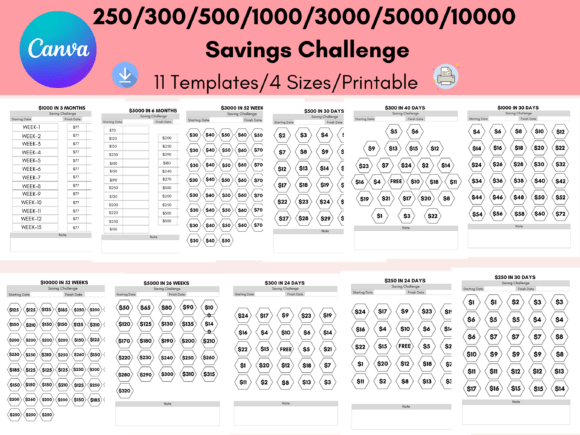
In project management and creative workflows, visual progress indicators are essential for maintaining momentum. The same principle applies to personal finance. Unleash your financial prowess with our compelling trove of 11 unique Money Saving Challenges, specifically crafted to provide a functional kick-start to your savings journey. These are not merely lists of numbers; they are interactive assets designed to reduce the cognitive load associated with budgeting. When you employ these dynamic, easily-traceable money saving trackers, you effortlessly squirrel away finances for unforeseen expenses, thus promoting effective debt management through positive reinforcement rather than restriction.
The psychological impact of tracking cannot be overstated. The real charm unfolds as you gradually color in your progress, providing a visual representation of your saved amount. This tactile or digital interaction creates a feedback loop similar to checking off tasks on a Kanban board or filling a progress bar in software development. It shifts the focus from the pain of parting with money to the satisfaction of completing a objective. For busy adults aged 20–50, this gamification element ensures that financial maintenance remains engaging even during high-stress periods.
Selecting the Right Challenge for Your Current Capacity
Effective planning requires matching the scope of the task to available resources. A savings challenge must align with your current cash flow, income frequency, and overarching financial targets. Our array of challenges includes options ranging from rapid micro-sprints to long-term marathons, allowing for precise calibration:
- 24 Day Save 250 Challenge: Ideal for short-term liquidity needs or testing a new budgeting habit without long-term commitment.
- 30 Day Save 250 Challenge: Fits neatly into standard monthly billing cycles, making it easy to sync with payday routines.
- 24 Day Save 300 Challenge: A slightly accelerated sprint for those with bi-weekly pay structures looking to build momentum.
- 40 Day Save 300 Challenge: Spans roughly six weeks, bridging the gap between monthly and quarterly planning horizons.
- 30 Day Save 500 Challenge: Targets moderate savings goals within a single month, suitable for specific purchase planning.
- 30-day Save 1,000 Challenge: An aggressive monthly target best suited for windfalls, tax refunds, or high-income months.
- 52 Week Save 3,000 Challenge: Among these, the notable 3000 Savings Challenge in 52-weeks is capable of serving myriad financial goals, such as debt clearance, affording a house down-payment, planning a holiday, or developing a robust emergency fund.
- 52 Week Save 10,000 Challenge: A comprehensive annual system for building significant capital reserves or investment funds.
- 26 Week Save 5,000 Challenge: A half-year intensive program perfect for meeting mid-year fiscal benchmarks.
- 6 Months Save 5,000 Challenge: Aligns with semi-annual business reviews or seasonal income fluctuations.
- Save 1,000 in 3 Months Challenge: A quarterly milestone tracker that integrates well with standard business quarter planning.
Selection should be data-driven. Before initiating a challenge, review the previous three months of discretionary spending. If your variance is high, start with a shorter duration like the 24 or 30-day options to establish baseline consistency. Once the workflow is stable, graduate to the 52-week or 6-month trackers to compound results.
Integrating Trackers into Broader Financial Workflows
A savings tracker does not exist in a vacuum. It interacts dynamically with other financial tools, banking platforms, and decision-making processes. To maximize efficiency, integrate the tracker at three critical junctures of your financial lifecycle.
Pre-Decision Planning
Before committing to a new expense, subscription, or business investment, consult your active savings tracker. The visual representation of your current progress acts as a constraint check. If coloring in a new expense would disrupt the visual flow or delay completion of a savings block, it forces a pause for reconsideration. This turns the tracker into an active decision-support tool rather than a passive record.
During Active Execution
Synchronize your tracker updates with existing administrative habits. For freelancers and small business owners, this might mean updating the savings chart immediately after invoicing or reconciling accounts. For salaried professionals, link the update to automated transfer notifications. By anchoring the tracking action to an established trigger, you eliminate the need for willpower. The tracker becomes a natural extension of your accounting or banking workflow, ensuring data accuracy and reducing administrative friction.
Post-Milestone Review
Upon completing a challenge, conduct a brief retrospective. Analyze which weeks were difficult and which were seamless. Did the 30-day structure align better with your cash flow than the 24-day sprint? Use these insights to select the next appropriate challenge from the list. This iterative approach mirrors agile methodology, where each cycle informs improvements in the next.
Customization and Brand Consistency for Creators
For educators, bloggers, publishers, and digital product sellers, these trackers serve a dual purpose: personal utility and commercial asset. To add impeccable customization, our variety of pre-arranged templates on Canva allows you to incorporate your unique color palette, logo, font, and icons to maintain brand consistency. This capability is crucial for professionals who wish to share their financial journey or sell planning resources.
When adapting these templates for publication or personal branding, consider the following usability factors:
- Visual Hierarchy: Ensure the savings amounts and dates remain legible against custom backgrounds. High contrast is essential for users printing at home.
- Format Compatibility: Provide both printable PDF versions and interactive digital versions compatible with tablet annotation apps like GoodNotes or Notability.
- Instructional Clarity: Include a brief "How to Use" section within the template. Users should understand whether to color in blocks upon depositing funds or upon reaching a balance threshold.
- Scalability: Design elements should retain quality across different print sizes and screen resolutions.
Easily publishable across online marketplaces, these customized trackers can generate passive income while reinforcing your authority in the productivity or finance niche. However, quality control is paramount. Test every template personally before distribution to ensure the math is accurate and the layout supports actual user behavior. A beautiful tracker that fails functionally will damage brand trust.
Practical Implementation Tips for Long-Term Success
Sustainability in savings challenges depends on reducing friction and accommodating real-world variability. Here are practical observations for maintaining momentum:
Automate Where Possible, Track Manually: Set up automatic transfers for the savings amount, but manually color in the tracker. The automation ensures the money moves, while the manual tracking preserves the psychological benefit and mindfulness of the process.
Create Buffer Zones: Life is unpredictable. If using a strict timeline like the 30-Day Save 500 Challenge, build in flexibility. Allow for "make-up" days or rollover amounts. Rigidity often leads to abandonment; adaptability fosters completion.
Contextualize the Goal: Label the tracker with the specific outcome. Instead of "Savings," write "Q3 Equipment Upgrade" or "Emergency Fund Tier 1." Specificity increases adherence by connecting the daily action to a meaningful professional or personal result.
Leverage Community Accountability: For marketers and community leaders, sharing progress (without revealing sensitive data) can enhance commitment. The social aspect of a challenge transforms solitary saving into a shared experience, leveraging peer support to maintain consistency.
Optimizing for Debt Management and Emergency Funds
While saving is often associated with accumulation, these challenges are equally potent for liability reduction. When applying a tracker to debt clearance, reframe the "savings" blocks as "debt destroyed." The visual filling of the chart then represents the elimination of obligations rather than the acquisition of assets. This reframing is particularly powerful for the 52 Week Save 3,000 Challenge when applied to credit card balances or student loans.
For emergency funds, the tracker serves as a security gauge. In times of financial stress, seeing a partially filled emergency fund chart provides tangible reassurance that systems are working. It prevents panic-selling of investments or high-interest borrowing by validating that a safety net is actively being constructed. Whether you are a freelancer navigating feast-and-famine cycles or a household managing fixed expenses, the tracker converts anxiety into actionable data.
Ultimately, the integration of a Money Saving Challenge and Savings Tracker into your routine is an exercise in intentional living. It moves finance from the background noise of life to the foreground of strategic planning. By selecting the right challenge, customizing the experience to fit your brand or personal aesthetic, and embedding the tracking process into existing workflows, you build a resilient financial foundation that supports both immediate needs and long-term ambitions.