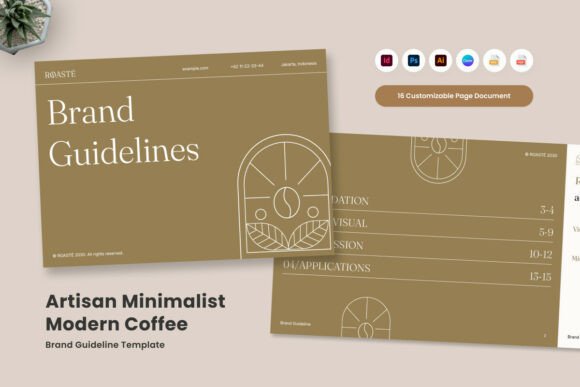
Coffee Artisan Minimal Brand Guideline: Building Identity Without Visual Clutter
Establishing a cohesive visual identity for a specialty coffee business requires more than just a well-designed logo; it demands a structured system that communicates quality, warmth, and expertise. The Coffee Artisan Minimal Brand Guideline serves as this foundational document, offering creative professionals and café owners a refined editorial structure that balances premium aesthetics with approachability. For roasteries, espresso bars, and lifestyle beverage brands, this template provides the necessary framework to ensure every customer touchpoint—from packaging to social media—feels intentional and sophisticated. However, possessing a high-quality template is only the first step. The true value lies in how effectively you adapt these standards to reflect your specific narrative without falling into common customization traps that can dilute your brand’s impact.
Understanding the Purpose of Minimalist Coffee Branding
Many entrepreneurs mistakenly view brand guidelines as mere decoration rather than a strategic operational tool. The Coffee Artisan Minimal Brand Guideline is designed specifically to support modern coffee branding by enforcing clarity through soft color tones, refined typography, and balanced layouts. When used correctly, it prevents the visual noise that often plagues new cafes trying to do too much at once. A common misunderstanding is assuming that "minimal" means "empty." In reality, effective minimalism in this context is about curated density. It ensures that the negative space highlights your product photography and messaging rather than distracting from it. If you treat this guideline as a rigid set of rules rather than a flexible narrative system, you risk creating a sterile environment that lacks the character essential to hospitality. The goal is to use the 16 customizable pages to build a presence that feels full of life, not devoid of it.
Avoiding Typography and Color Consistency Errors
One of the most frequent mistakes when implementing this type of brand book is ignoring the pre-set paragraph and character styles included in the file. Users often manually adjust font sizes or colors on individual pages, which breaks the global consistency the template was built to maintain. This leads to a disjointed final output where headers vary slightly in weight or body text shifts in leading across different sections. Such inconsistencies subconsciously signal a lack of professionalism to consumers. To avoid this, always utilize the master styles provided in the Adobe InDesign or Illustrator files. These styles are engineered to work harmoniously with the free fonts included. By adhering to the established hierarchy, you ensure that your menu boards match your website and your packaging aligns with your signage. Remember, the template includes specific font info documentation for a reason; deviating without understanding typographic pairing principles can undermine the elegant minimalist approach intended to give your brand a high-end appeal.
Technical Preparation for Print and Digital Versatility
A significant oversight occurs when creators focus solely on digital presentation and neglect print specifications until the final hour. The Coffee Artisan Minimal Brand Guideline is formatted in A4 size with a 3mm bleed and set to CMYK 300 dpi, making it ready for professional printing. Failing to respect these technical parameters can result in cropped content, pixelated images, or color shifts when moving from screen to paper. RGB colors viewed on a monitor will never perfectly replicate CMYK ink on uncoated paper stock, which is popular in artisan coffee branding. Before sending any asset to production, verify that your images meet the resolution requirements and that your color profiles are correctly assigned. Utilizing the included PSD and EPS files allows for proper color management that PDF exports sometimes obscure. Checking these technical details early saves costly reprinting fees and ensures your physical brand collateral matches the polished look of your digital proofs.
Navigating Software Compatibility and File Formats
Not every user has access to the full Adobe Creative Cloud suite, yet many attempt to force incompatible workflows that degrade file integrity. While this guideline offers robust .INDD, .AI, and .PSD files for professionals, it also includes a Canva link for those who need accessibility. A critical error arises when users try to edit complex vector layouts in raster-based programs or import high-fidelity InDesign files into basic design tools without understanding the limitations. This often results in lost editable text, broken links, or flattened layers that cannot be updated later. Evaluate your team’s actual skill level before choosing your primary editing platform. If you are a freelancer delivering to a client who only knows Canva, start there or create simplified derivatives. Conversely, if you require precise typographic control and print-ready outputs, stick to the native Adobe files. Leveraging the right format for your specific workflow preserves the editability of text, colors, and objects, ensuring the brand remains sustainable as your business evolves.
Curating Photography and Visual Narrative
The template emphasizes timeless photography guidelines, but users frequently undermine this by inserting generic stock imagery that clashes with the artisan aesthetic. The guideline is designed to frame authentic moments—the texture of roasted beans, the steam of an espresso pull, the hands of a barista. Replacing these placeholders with overly saturated, artificial, or inconsistent photos creates a tonal disconnect that confuses customers. Your visual assets must adhere to the same soft, refined palette defined in your color standards. Before finalizing your brand book, audit every image against the mood board established in the early pages. Does the lighting match? Is the composition balanced? Does it feel premium yet approachable? Using the Coffee Artisan Minimal Brand Guideline effectively means treating photography as an extension of your typography and color strategy, not as an afterthought. Authenticity builds trust, and in the specialty coffee market, trust is as important as taste.
Evaluating Customization vs. Template Integrity
There is a delicate balance between making the template your own and breaking its structural logic. Some users feel compelled to change every element immediately to prove uniqueness, inadvertently destroying the carefully calibrated grid system that makes the layout work. Instead of overhauling the foundation, focus on customizing the content within the existing framework. Adjust the accent colors to match your roast profile, rewrite the copy to reflect your origin story, and swap icons to suit your service style. The 16 pages are fully editable for a reason, but they are also interconnected. Changing a margin on page four might affect the alignment on page twelve. Approach customization iteratively. Test changes across multiple spreads to ensure the cohesive brand presence remains intact. This disciplined approach yields a result that feels bespoke without sacrificing the professional polish that attracted you to the Coffee Artisan Minimal Brand Guideline in the first place.
Making an Informed Decision for Your Brand
Before downloading or purchasing, assess whether your current brand maturity aligns with what this guideline offers. It is ideal for businesses seeking clarity and visual sophistication, but it may not suit brands aiming for chaotic, grunge, or maximalist aesthetics. Review the included file list to confirm you have the necessary software or access to the Canva alternative. Consider your long-term needs: will you need to add pages later? The modular nature of the InDesign and Illustrator files supports expansion, but only if you maintain the original styling conventions. Ultimately, this resource is a vessel for your story. Its success depends entirely on your willingness to respect its design principles while confidently injecting your unique character. By avoiding common pitfalls regarding technical specs, stylistic consistency, and photographic tone, you transform a static template into a dynamic asset that elevates your coffee business above the competition.